Construction on subsidence soils requires a special approach. Such foundations are capable of changing their properties under the influence of moisture and load, which can lead to uneven settlement of the building and damage to structures.
That is why the choice of foundation strengthening technology becomes one of the key design stages.
One of the most effective methods of strengthening is considered to be alkaline treatment of subsidence soils. Foundations on collapsible soils has been successfully used for several decades in the construction of industrial, civil and infrastructure facilities.
What are subsidence soils
Subsidence soils are distinguished by the fact that when moistened, their structure loses stability. Under the weight of the building, such foundations can become significantly compacted, causing deformation of the foundations, cracks in the walls and other problems.
Most often, such soils include loess and some types of clayey rocks, common in many regions.
Therefore, before construction, specialists must carry out engineering and geological surveys to determine the characteristics of the foundation.
What is alkaline treatment
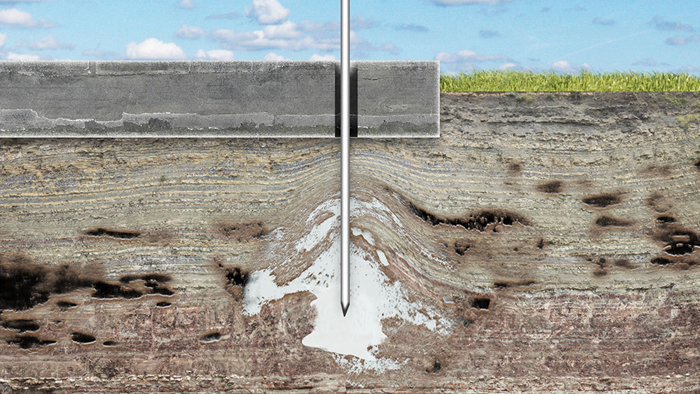
Alkaline treatment is a chemical method of strengthening the soil, in which an alkaline solution is introduced into the base through special injectors or screw pile shafts.
After entering the soil, the solution interacts with clay particles, changing their structure. As a result:
- subsidence is eliminated;
- the bearing capacity of the base increases significantly;
- soil resistance to loads increases;
- the likelihood of uneven settlement of the building is reduced.
After completion of processing, the soil acquires properties close to semi-rock, which makes it possible to use it for the construction of various objects.
Advantages of technology
Practice shows that alkaline treatment has a number of significant advantages over other methods of strengthening the base.
The main advantages include:
- increasing the bearing capacity of the soil;
- elimination of the risk of drawdown;
- possibility of construction in difficult areas;
- reducing the volume of excavation work;
- reducing the cost of foundation construction;
- high durability of the result.
Compared to completely replacing the soil or using extra-long piles, the technology can significantly reduce costs without compromising the reliability of the future structure.