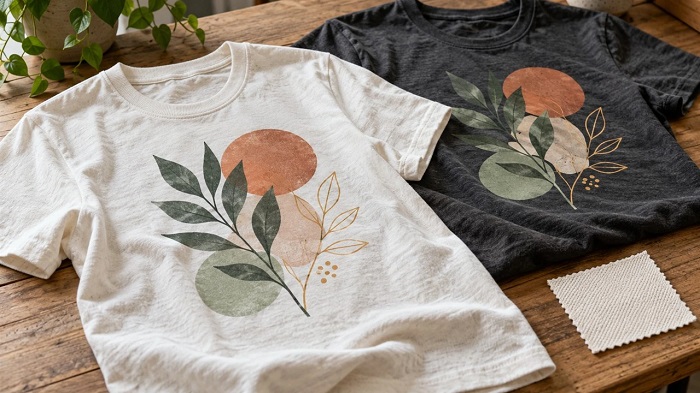
When apparel brands, illustration studios, and museum or cultural merchandisers produce limited-edition cotton T-shirts featuring intricate linework and smooth watercolour transitions, commercial direct-to-garment (DTG) printing holds a decisive technical advantage over screen printing and contour-cut heat transfers: variable-droplet inkjet heads jet continuous CMYK tonal transitions directly into the cotton yarn without requiring mechanical cut lines, adhesive borders, or separate halftone screens for every hue.
Achieving gallery-grade colour fidelity across both natural off-white and charcoal cotton blanks, however, requires disciplined RIP profile calibration, precise white-underbase registration, and smooth ring-spun fabric selection.
Why Variable-Droplet DTG Outperforms Film Transfers on Delicate Artwork
Illustrated merchandise—such as botanical studies, architectural line drawings, anime character art, and soft airbrush vignettes—frequently combines hairline dark strokes with whisper-thin pastel washes that fade to zero opacity at the edges. On film-based transfers (such as DTF or vinyl print-and-cut), any pixel near the edge of a vignette must be thick enough to hold hot-melt adhesive powder or accept a plotter knife path, often forcing designers to add a solid background keyline or coarsen the fade into visible halftone dots.
In a commercial water-based DTG system, fine linework and feather-light gradients behave differently:
- Zero carrier border around floating filaments: Isolated 0.5 mm ink strokes, floating botanical leaves, and stippled pencil shading sink directly into the combed cotton fibres with no surrounding clear adhesive halo.
- Continuous multi-shade transitions without screen count penalties: Whether an illustration uses three colours or three hundred subtle skin-tone and sky gradients, a single DTG pass reproduces the full RGB-to-CMYK perceptual gamut at the same per-shirt setup cost.
- Soft matte reflection matching fine-art paper: Because cured water-based pigment ink adopts the matte micro-texture of the underlying cotton knit, illustrated prints avoid the artificial plastic glare common on heat-laminated films.
Artwork Preparation and RIP Settings Across Light, Mid-Tone, and Dark Cotton
To prevent delicate gradients from looking muddy or chalky on finished shirts, pre-press operators must tailor the white underbase strategy in the RIP software to the brightness of the cotton blank.
| Garment Shade Tier | White Underbase Strategy in RIP | Gradient & Fine-Line Handling | Essential Quality Check |
|---|---|---|---|
| Bleached white & natural ecru cotton | CMYK only (or selective white highlight only under pure white elements on ecru) | Fades blend directly into the raw cotton background with zero underbase edge | Verify whether the specific blank finish and wash target require light pre-treatment before running volume |
| Heather grey & muted pastel cotton | Reduced-density adaptive white base under bright colours; no white under dark linework | Use RIP colour-substitution so black and dark charcoal lines print with black ink alone | Check a 2-pixel white choke to ensure no white halo peeks out around thin dark outlines |
| Deep charcoal, navy, & black cotton | Full white underbase under opaque colours + graduated white feathering or micro-halftone at fade edges | Convert soft outer drop shadows to shirt-colour knockouts or controlled halftone fades | Pre-press pre-treated fabric flat so stray cotton fibrils do not break up hairline vectors |
Preventing White-Edge Peeking and Dot Gain on Combed Cotton
Two technical pitfalls can ruin a fine-line illustration on dark cotton: white underbase misregistration (peeking) and capillary dot gain on loosely spun fabric. When an artwork file contains 1-point dark outlines layered over a pale watercolour wash, printing a 100% white underbase all the way to the outer edge of the dark outline almost guarantees a faint white rim if the cotton knit shifts by even a fraction of a millimetre between the white and colour passes.
Experienced DTG operators solve this in the RIP by applying a 2- to 3-pixel white choke (pulling the white base slightly inside the CMYK boundary) and disabling white ink entirely beneath pure black line art. Equally important is blank selection: printing 1200 dpi fine-line illustrations onto rough, open-end carded cotton results in blurry lines because loose surface fuzz wicks wet droplets sideways. Specifying tightly woven, 100% combed ring-spun cotton and flattening the print zone on a heat press prior to printing preserves crisp vector edges.
Selecting Multi-Head Commercial DTG Hardware for High-Precision Art Runs
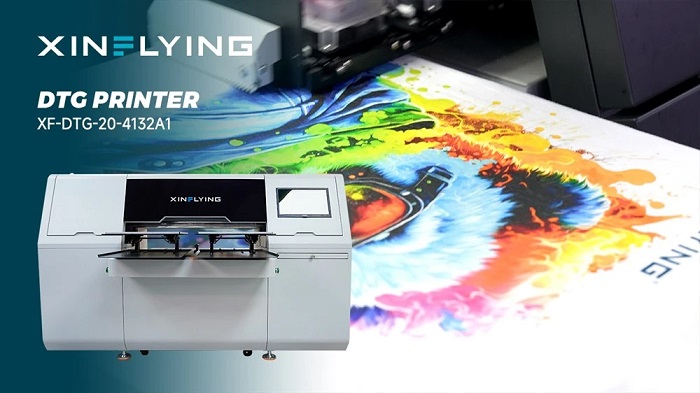
Maintaining tight drop-on-drop registration between the white underbase and the CMYK colour layer across an eight-hour shift requires a rigid industrial carriage frame and synchronized multi-head jetting. Print shops and merchandise studios evaluating high-precision platforms such as the XINFLYING XF-DTG-20 (including the four-head XF-DTG-20-4I32A1 dual-platen system) can review the full specifications across XINFLYING commercial DTG garment printers to compare printhead alignment architecture, white-ink circulation controls, and platen tolerances.
By pairing an industrial multi-head platform like the XINFLYING XF-DTG-20 with combed ring-spun blanks and disciplined RIP white-choke presets, apparel decorators can turn complex multi-colour illustrations into retail-ready cotton merchandise with zero setup friction.