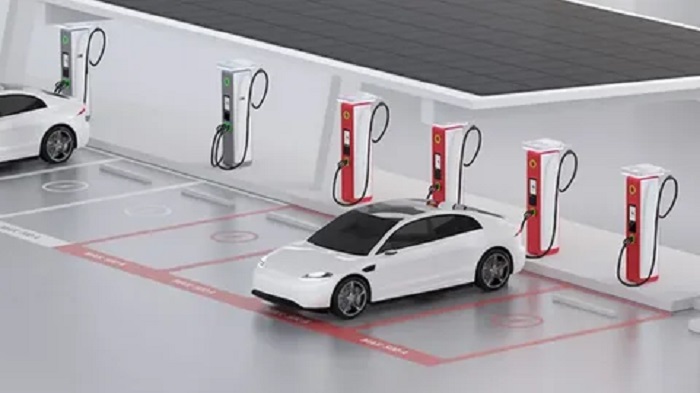
An EV charger looks simple from the outside: plug in, charge, drive away. The harder part happens behind the wall, where the charger becomes one of the largest electrical loads in the building. Add solar, backup power, or peak pricing, and that simple charger starts to look like only one piece of a bigger energy puzzle.
That is where ESS enters the conversation. An energy storage system, or ESS, is a battery-based system that stores electricity and releases it later when the building needs it more. Pairing an EV charger with ESS can reduce pressure on the grid connection, make better use of solar power, and keep charging more predictable during outages or expensive peak hours.
The Charger Is Not Always the Bottleneck
A standard Level 2 home charger may be perfectly adequate for a single EV and a stable electrical panel. The question changes when charging overlaps with air conditioning, cooking, laundry, and evening peak rates. At that point, the problem is not only how fast the car can charge. It is how the whole site handles demand.
The U.S. Department of Energy’s Alternative Fuels Data Center notes that battery energy storage can support EV fast charging where grid capacity is limited and can reduce peak power pulled from the grid. In plain English, the battery acts like a buffer. It can charge slowly from solar or the grid, then discharge quickly when the EV needs power.
For homes, this may mean storing afternoon solar for a car that comes home after sunset. For businesses, it may mean adding charging without triggering a costly service upgrade or a new demand charge every time two drivers plug in at once.
Where ESS Adds Real Value
An EV charger with ESS makes the most sense when there is a specific energy problem to solve. It is not automatically the best choice just because it sounds more advanced.
- A home produces solar power during the day but charges the EV mostly at night.
- The utility uses time-of-use rates, with expensive evening electricity.
- The building has limited electrical capacity but needs reliable charging.
- Backup power matters during storms, wildfires, or weak-grid conditions.
- A commercial site wants EV charging without uncontrolled demand spikes.
This is also why the product category often overlaps with whole-home or whole-building energy management. A charger, battery, inverter, solar array, and software layer need to communicate. If each device acts alone, the system may still work, but it will not be very smart.
The V2H and V2G Angle
Vehicle-to-home, usually shortened to V2H, lets a compatible EV send power back to a house. Vehicle-to-grid, or V2G, allows power to flow back toward the grid when the local utility program supports it. The U.S. Department of Energy says bidirectional charging can provide backup power and demand-response benefits, but only with compatible vehicles, chargers, controls, and interconnection rules.
ESYsunhome lists the EV22 V2E as a 22 kW bidirectional DC charger that is V2H and V2G ready, which puts it in a different category from a basic wall charger. It is meant to participate in an energy system, not simply refill a battery overnight.
For a homeowner or site owner comparing options, ESYsunhome is useful as a starting point because the brand organizes storage, EV charging, home solutions, and commercial systems under the same energy-management umbrella.
When a Simpler Setup Wins
A charger-plus-ESS setup is not necessary for every driveway. If the home has low flat electricity rates, no solar, a strong electrical panel, and light daily driving, a standard Level 2 charger may be enough. ENERGY STAR says certified Level 1 and Level 2 chargers use about 40 percent less energy in standby mode than standard models, so efficiency can still improve without adding storage.
ESS becomes compelling when the charger is part of a broader plan: solar self-use, backup power, load shifting, or commercial resilience. In that setting, the charger stops being just a plug and becomes a controllable part of the building’s energy strategy.